What does Blood pressure mean? Process of Fluid transfer.
Blood pressure
Blood pressure (BP) refers to the pressure created in the arteries by blood as the heart contracts & relaxes.
During a heartbeat cycle, the maximum pressure is referred to as systolic pressure & the minimum diastolic pressure. Blood pressure is expressed in millimeters of mercury & as systolic/diastolic, that is 120/80 mm Hg.
The process of fluid transfer between the capillaries & tissue
The most tissues have an extensive network of capillaries. Capillaries are the site of the exchange of fluid between the blood & tissues. The flow of blood in the capillaries is controlled by the pre capillary sphincter which is located between arterioles & capillaries. The thin wall of capillaries which are made of a single layer of endothelial cell & differences in blood pressure & osmotic potential across the walls of a capillary is responsible for the exchange of fluid.
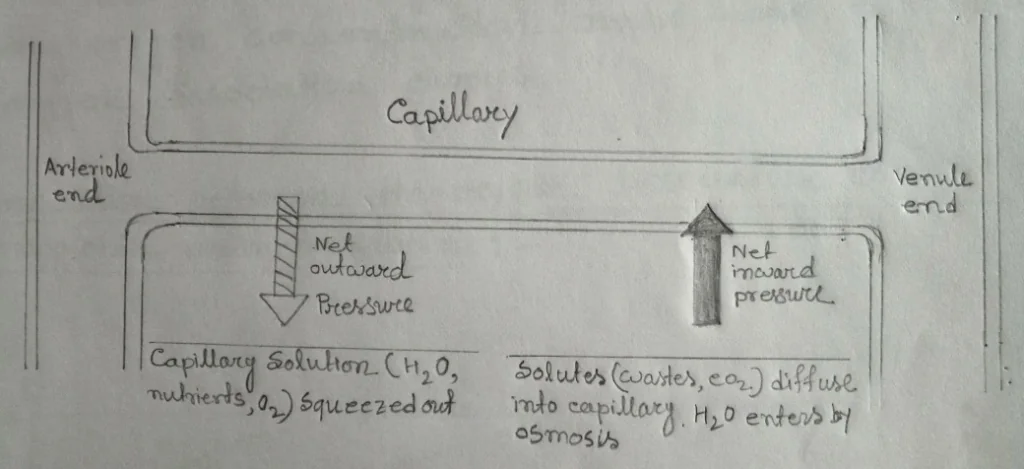
Fig: Fluid exchange across a capillary wall
When the blood leaving an arteriole to enter a capillary is at a relatively high pressure which overcomes the local osmotic potential. Because of this blood fluids are squeezed out of the capillary. And when blood leaving a capillary to enter a venue is at a relatively low pressure that does not overcome the local osmotic potential, even though the latter is also relatively low. As a result, water enters the capillary by osmosis. So, in this process, the exchange of fluid occurs by simple diffusion across the capillary wall.